What to Know Before You Decide
Retractable privacy screens outlast outdoor curtains in Ontario weather by a wide margin. Curtains are lower cost upfront but typically need replacement every one to two seasons due to UV degradation, mildew, and wind damage. The total cost of ownership over three years is often comparable — with screens delivering better privacy, cleaner operation, and no seasonal takedown.
Outdoor curtains have become popular because they are inexpensive and available at home improvement stores. But in a GTA climate — with wet springs, hot humid summers, and strong fall winds — fabric curtains face the full range of conditions that cause the fastest degradation.
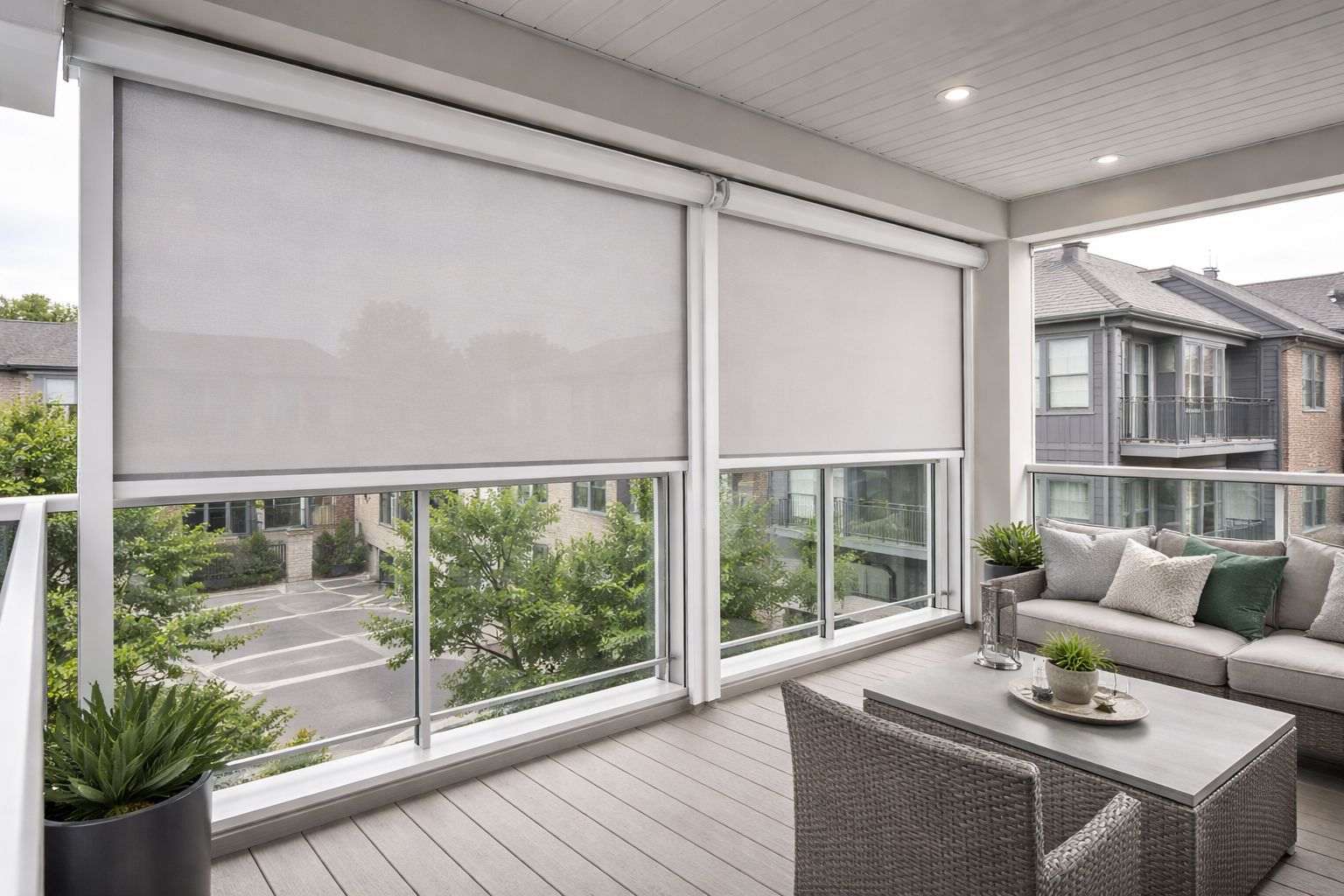
Retractable privacy screens are engineered outdoor products: UV-stabilized fabrics, aluminum hardware, and spring or motor mechanisms that retract the screen fully when not in use. The comparison is not only about aesthetics — it is about what actually holds up.

Where curtains fall short in Ontario conditions
Outdoor curtains are typically made from polyester or linen-blend fabrics with a UV-resistant coating. That coating degrades within one to two seasons of direct sun exposure. Once it breaks down, the fabric fades, becomes brittle, and starts to hold moisture — which leads to mildew staining.
Wind is the other major factor. Curtains hang from a rod and move freely. In sustained winds — which are common on exposed patios, elevated decks, and open backyards — curtain panels flap, tangle, and put stress on the mounting hardware. Grommets tear. Panels wrap around posts. The mounting eventually fails.
What retractable screens do differently
Retractable patio privacy screens use marine-grade or commercial outdoor mesh fabrics that are solution-dyed at the fibre level. The colour does not fade because it is not a surface coating — it is built into the fibre itself. These fabrics are rated for 10+ years of UV exposure in direct sun conditions.
The screen also retracts into a protected cassette housing when not in use. It is not exposed to rain, wind, and sun 24 hours a day. That dramatically extends the lifespan of both the fabric and the hardware.
Total cost comparison over three seasons
A set of outdoor curtain panels for a standard patio opening typically costs $80–$200 and lasts one to two seasons before fading and mildew make replacement necessary. Over three seasons, that is $240–$600 — plus the time and effort of seasonal takedown, storage, laundering, and reinstallation.
A retractable privacy screen for the same opening is a higher upfront cost but requires no seasonal removal, no annual replacement, and minimal maintenance. The long-term cost difference is smaller than the upfront price suggests.
When outdoor curtains are a reasonable choice
Curtains can work if the space is a covered porch or interior courtyard where direct weather exposure is limited. In that context, UV degradation is slower and wind is less of a factor. The takedown requirement is still there, but in a sheltered space the replacement cycle extends.
Curtains also make sense as a short-term solution while a retractable screen is being planned and measured. Using curtains for one season while deciding on the permanent setup is reasonable — just do not expect them to substitute long-term.
Privacy performance comparison
- Curtains move in wind, which opens gaps in privacy coverage unpredictably.
- Retractable screens deploy to a fixed position and stay there.
- Curtains do not retract — they are always partially visible or must be pushed aside.
- Screens retract completely out of sight into the cassette housing.
- At night with interior lighting, both options transmit silhouettes — fabric density matters more than curtain vs. screen.