What to Know Before You Decide
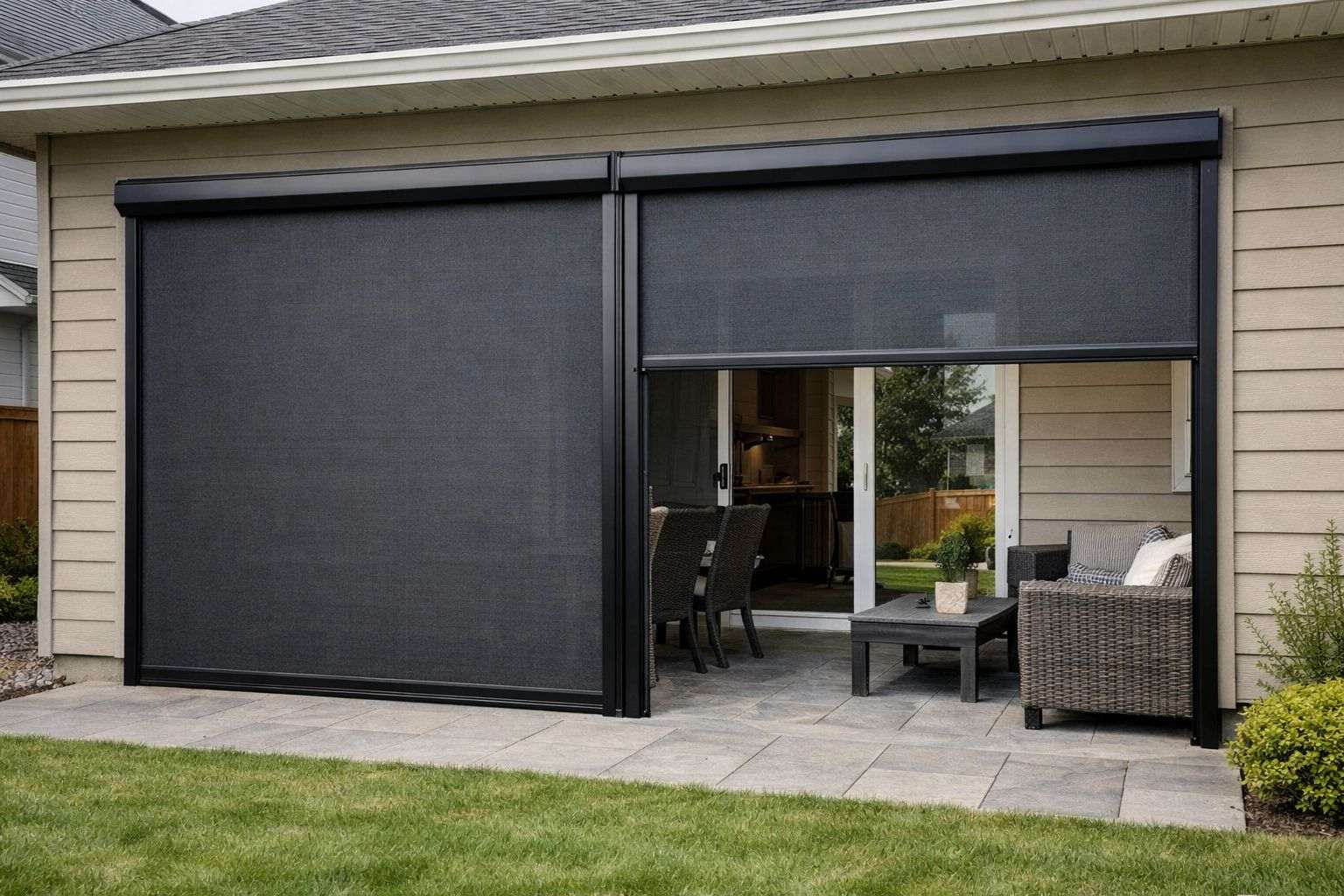
Retractable privacy screens are a better fit for most GTA townhouse patios than fences because they block sightlines at the height where exposure actually happens — not just at grade — and they retract fully when privacy is not needed. Fence additions on shared walls are often restricted by condo rules or HOA agreements anyway.
GTA townhouse communities in Markham, Vaughan, Richmond Hill, and Thornhill are designed with smaller lots and closer spacing than detached-home neighbourhoods. That layout creates specific privacy challenges that standard solutions do not handle well.
Understanding why townhouse patios are different helps explain why retractable privacy screens solve the problem better than a taller fence, more planting, or a permanent structure.
Why townhouse patios are harder to screen than detached-home yards
Townhouse patios are typically bounded by a shared fence on both sides, a back wall or unit behind, and a patio door directly into the unit. The spacing between units is often narrow enough that a direct sightline exists from a neighbour's patio or window straight into your seating area.
Fences already exist on the property line. Taller fence additions are often restricted. Landscaping takes years to establish and still leaves a gap above the fence line at second-storey window height. A retractable screen mounts above the patio door or to an existing post or fascia, drops to the specific height needed, and retracts when not in use.
The patio door opening is the most common problem
Most GTA townhouse patios open directly through a sliding patio door or double French door. When that door is open, the interior of the unit is visible from the side or from the back. A patio door privacy screen drops across that opening, blocks the sightline, and still lets air flow through depending on the fabric selected.
That single screen often solves the most visible privacy issue without requiring any structural changes. It mounts to the door frame or adjacent framing and retracts into a compact cassette above the opening.
Side exposure and neighbour patio sightlines
The second most common issue is the side sightline — the angle from a neighbouring patio or ground-floor window into the seating area. A single patio privacy screen on the exposed side can block that view while leaving the patio open on the other sides.
In denser townhouse complexes, both sides sometimes need screening. Two independent retractable screens — one per side — handle that condition without requiring a permanent enclosure.
Balcony units and stacked townhouses
Stacked townhouses and back-to-back units often have a balcony instead of a ground-level patio. Balcony conditions are different — railing mounts are the norm, HOA rules about permanent modifications are stricter, and the sightlines are often from below rather than from the side. Balcony privacy screens address that condition specifically.
The same rule applies here: a retractable screen retracts fully and does not change the visual profile of the building, which makes it easier to get approval in managed communities.
What to check before ordering
- Review HOA or condo rules for restrictions on patio modifications.
- Identify which opening or sightline causes the most discomfort.
- Check whether the patio door frame has enough clearance for a cassette mount.
- Measure the width of any exposed side openings — wider openings may need two panels or a split-panel configuration.
- Decide whether air flow matters or whether a denser fabric for full privacy is preferred.
Common GTA townhouse layouts and the screens that fit them
Newer townhouse developments in Vaughan, Markham, and Richmond Hill typically use narrower lot widths with the patio at the back. The most common setup is a patio door screen plus one side screen on the exposed neighbour-facing side. Older townhouse rows in Thornhill and North York may have wider patio openings that benefit from a split-panel configuration.
Send photos of the space and we can confirm which configuration fits and which fabric makes sense for the exposure before any commitment.