What to Know Before You Decide
A single manual retractable privacy screen installed on a standard residential opening in the Toronto and GTA market typically starts around $800. A motorized screen of the same size starts around $1,600. Most residential projects land somewhere in the $1,500 to $4,500 range per opening installed, depending on size, fabric, motor, and mounting complexity.
Those numbers are a starting point, not a flat quote. Every retractable privacy screen is custom-measured and custom-fabricated for the exact opening it covers, so the final price changes based on the specifics of the space. The six factors below account for most of the variation from project to project.
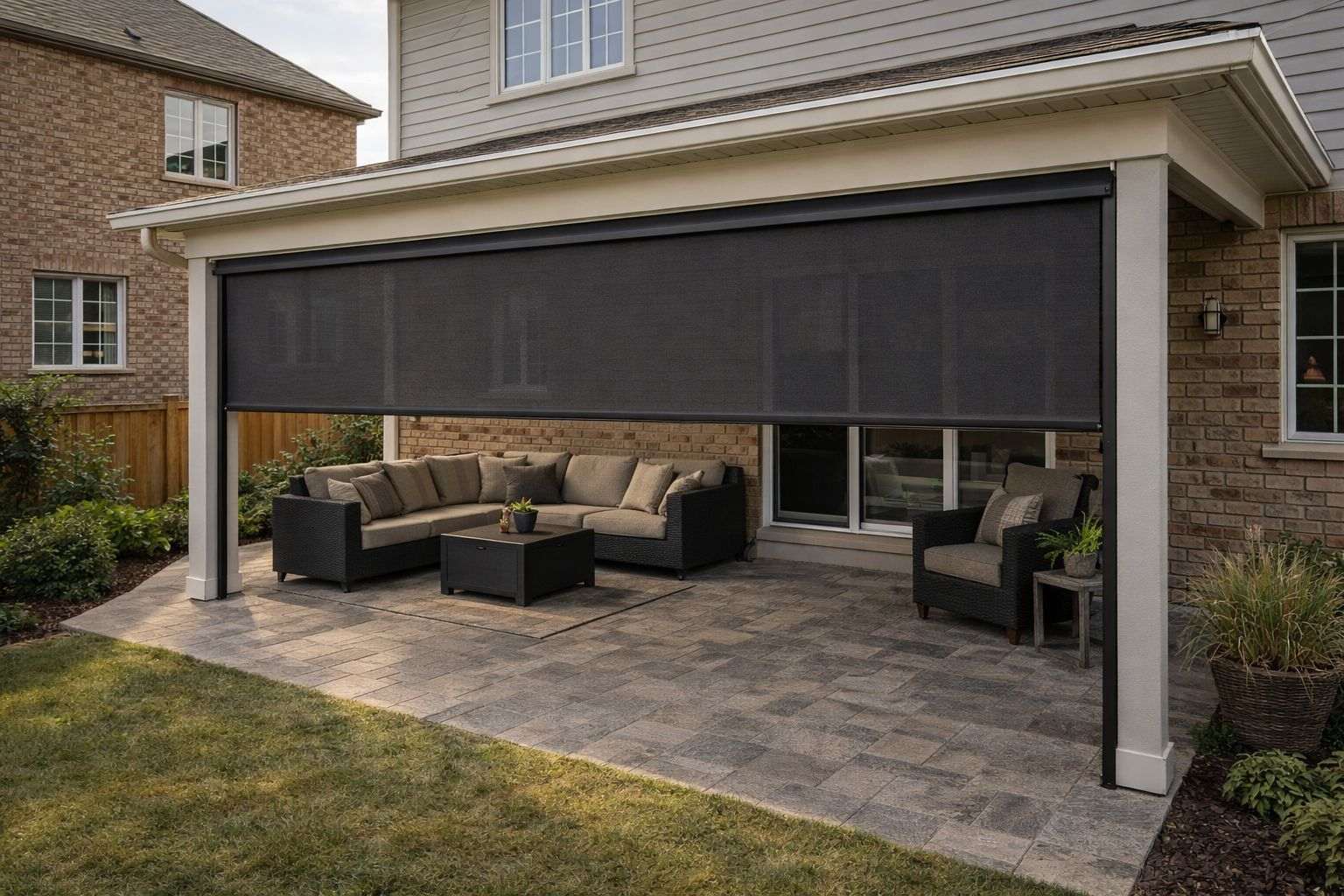
Why there is no flat published price
Every retractable privacy screen is built to order. The aluminum housing, side channels, bottom bar, fabric panel, and mounting hardware are all fabricated or cut to fit the exact opening — there is no stock unit that pulls off a shelf.
That is why no credible installer in the GTA publishes a flat rate. Two openings that look similar can end up costing noticeably different amounts depending on fabric choice, how the screen mounts to the structure, and whether motorization is in scope. A site visit or detailed photos are what make an accurate quote possible.
Driver 1: Opening size
Width and height both move the price. Standard residential sizes — roughly up to 12 feet wide by 10 feet tall — sit at the base of the range. Wider or taller openings use more fabric, more aluminum, and usually a larger motor tube, which all raise the cost.
Openings over 14 feet wide almost always require motorization because a manual crank becomes unreasonable at that scale. That shifts the project from the manual price band into the motorized band even if the homeowner originally preferred manual. For the full manual-versus-motorized breakdown, see our manual vs motorized privacy screens guide.
Driver 2: Number of screens on the project
Single-screen projects cost more per screen than multi-screen projects. Site visit, measurement, and installation time get amortized across the whole job, so a pergola with three or four screens carries a lower per-screen cost than a single patio side.
That does not mean bigger is always better. The right number of screens is whatever the space actually needs. But if you are weighing whether to add the second or third opening during the same install, doing them together is usually cheaper per screen than coming back later.
Driver 3: Fabric choice
Fabric price varies more than most buyers expect. A basic insect-mesh fabric sits at the low end. Premium options like Soltis Proof 502 (a blackout PVC fabric) or PanoramaFR (fire-rated clear vinyl) can run two to three times the cost of the base mesh.
Most residential buyers end up on one of two mid-range fabrics — SunTex 90 or SunTex 95 — which balance privacy, heat control, and cost. The fabric choice only matters if you pick the wrong one for the problem. For a full breakdown of each fabric, see our guide to all 6 privacy screen fabrics.
Driver 4: Manual versus motorized (and which tier)
Motorization is the single biggest line item on most quotes. A manual screen starts around $800 installed. A motorized screen with a basic Somfy motor and a wall switch starts around $1,600 — roughly double the manual price for the same opening.
Within motorized, the control tier matters too. A wall switch is the simplest setup. A Somfy Telis remote adds a small premium. Full smart-home integration with Somfy TaHomA or the myLink app, plus Alexa, Google Home, or Apple Home support, usually adds a few hundred dollars per screen. Automated sun and wind sensors are an additional upgrade on top of that.
- Manual crank — starts around $800 per opening installed
- Basic motorized with wall switch — starts around $1,600
- Motorized with Somfy remote — small premium over basic motorized
- Motorized with smart-home app and voice control — several hundred dollars more per screen
- Motorized with sun and wind sensors — additional premium on top of smart-home tier
Driver 5: Mounting complexity
Where the screen attaches affects install time and hardware cost. A flat wood-framed wall with an electrical outlet nearby is the simplest install. Pergola posts, soffit-mount conditions, brick or stone facades, and elevated balconies each add labour or specialized hardware.
Mounting is also where hidden costs tend to surface on lower-quality quotes — electrical runs, fascia reinforcement, or structural blocking for soffit mounts. A proper site visit flags those requirements before the install date. Our deck privacy screens and patio privacy screens pages cover the mounting considerations for the most common applications.
Driver 6: Electrical and site access
Motorized screens need power. If an outlet already sits within reach of the motor tube, the install is straightforward. If a new electrical junction is required, that may need a separate electrician or additional hours on the install.
Site access matters too. A ground-floor patio is easier to work on than a third-storey balcony or a roof terrace. Access, parking, and material handling on harder-to-reach sites can add to the labour line.
What a complete installed quote usually includes
A straightforward Privacy Shade quote for a residential screen covers everything required to leave a working system behind at the end of the install day.
- Free site visit and measurement
- Custom fabrication of the screen housing, side channels, and bottom bar
- Fabric panel fabricated to the exact opening dimensions
- Somfy motor and basic controls (if motorized)
- Standard mounting hardware and fasteners
- Installation labour
- Five-year warranty on the system (with full Somfy motor warranty on motorized units)
What is usually extra
- New electrical circuits or outlet installations beyond simple relocation
- Sun and wind sensors
- Smart-home integration setup and configuration
- Permits where required — see our Ontario permit guide for the situations that typically need one
- Structural reinforcement for unusual mounting conditions
Ways to manage budget without compromising the result
Most budget-conscious projects do not need to drop from motorized to manual — they just need to make the right choices in the other five drivers.
- Start with the openings that matter most and plan additional screens for a future phase
- Choose manual for single, reachable openings where daily adjustment is not a concern
- Stay within standard sizes where the layout allows
- Share one motor controller across grouped screens on the same facade
- Pick the fabric that matches the actual problem instead of over-specifying privacy or blackout when solar control is the real need
Getting an accurate number for your space
The only way to get a real quote is for someone to see the opening. A site visit takes about 30 minutes, is free, and produces a detailed estimate broken down by screen so you can see exactly where the price comes from.
Before the visit, photos and rough opening dimensions help us give you a realistic estimate range over email — enough to confirm the project is in your budget before we schedule time on site. Send a few photos and we will take it from there.