What to Know Before You Decide
Motorized outdoor screens are worth it when you have multiple openings to cover, screens wider than roughly 10 feet, or a space you adjust frequently enough that daily manual operation becomes inconvenient. For a single easy-to-reach opening, manual is often the better value.
Motorized outdoor screens can make a patio, pergola, porch, balcony, or garage opening much more usable, but the value depends on what is making the space uncomfortable now.
If the real problem is privacy, glare, wind, bugs, or low-angle sun, the value can be very easy to justify. If the only issue is open overhead sun, the better answer may be an awning instead, and if you already know the space needs a screen the next decision is often whether manual or motorized operation makes more sense.
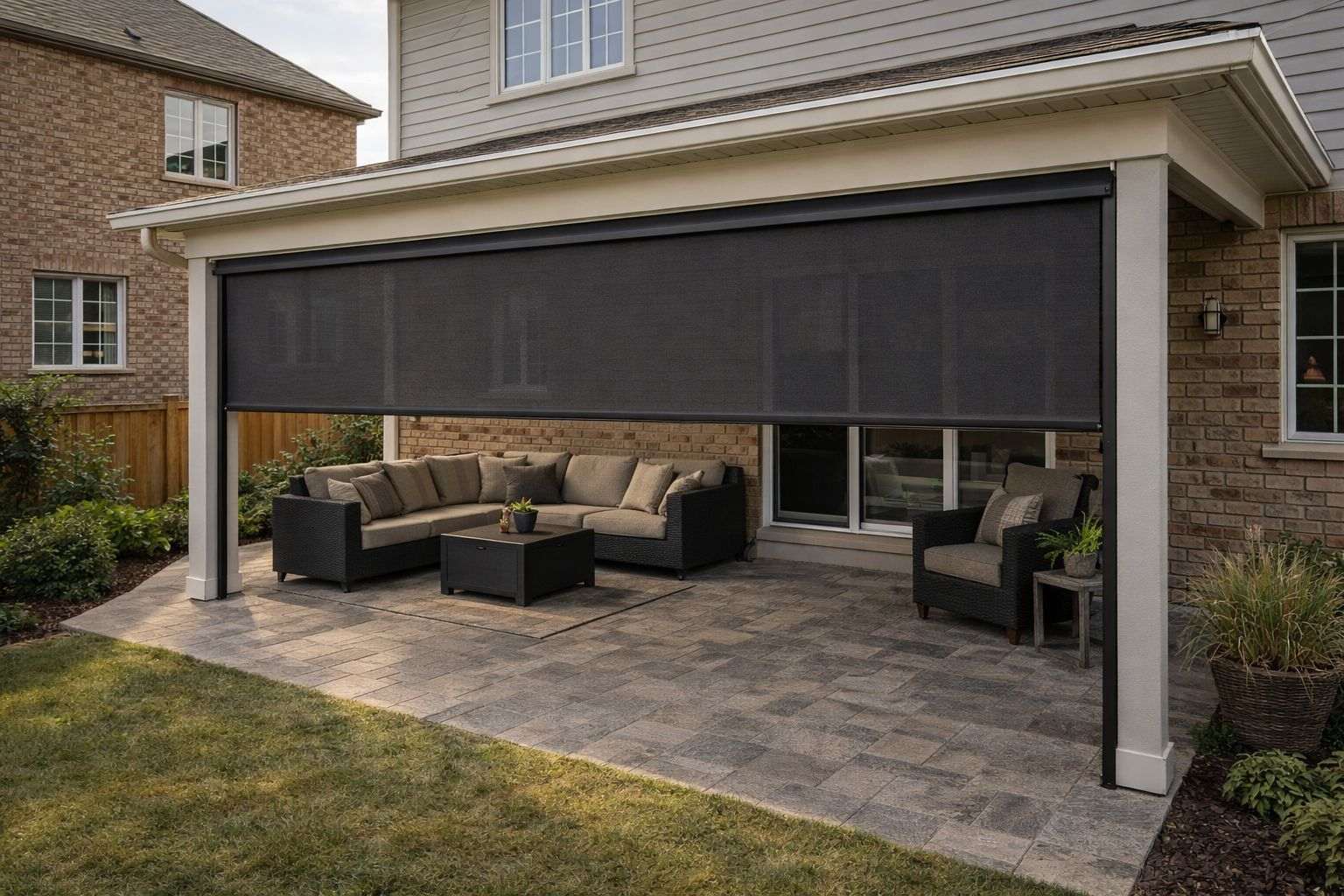
What a motorized outdoor screen actually does
A motorized outdoor screen retracts vertically so you can open or close the space as conditions change. Depending on the fabric and opening, it can help with privacy, daytime glare, airflow control, insects, and side exposure. That is why it is so often used on patios, pergolas, porches, and balconies.
The biggest advantages
- They keep the space visually cleaner than fixed walls, curtains, or improvised seasonal barriers.
- They let you open the area when conditions are good and close it when privacy or glare becomes a problem.
- They improve usability without permanently boxing in the space.
- They work especially well in applications like pergolas, window-facing openings, and patio door edges where side protection matters more than overhead shade.
What they do not do
A motorized screen is not the same thing as a full sunroom or a hard weatherproof enclosure.
- It does not replace a roof.
- It does not solve every weather condition or create a fully conditioned room.
- Performance depends on the fabric, mounting condition, span, wind exposure, and how open the structure is.
- If the main issue is direct sun from above on an open patio, an awning may be the stronger category choice.
When they are worth the investment
Screens usually feel worth it when they fix a problem that is otherwise hard to solve cleanly. That could be a pergola opening with heavy late-day glare, a covered patio with direct neighbour views, or a backyard that becomes too windy to enjoy during dinner hours.
We see that most often on projects in Richmond Hill, Vaughan, and Newmarket, where outdoor living spaces are already used regularly and just need more control to stay comfortable.

When they may not be the right fit
- If the only real problem is overhead sun on a fully open patio.
- If there is no suitable mounting surface or structure for the opening.
- If you need a full weatherproof enclosure rather than a flexible screen system.
- If the space is rarely used and the discomfort is too minor to justify the investment.
Features worth paying attention to
Not all systems behave the same way. Fabric openness, guide design, motorization, and the overall layout of the opening all affect performance. It is also worth comparing the actual fabric options, especially if you are choosing between something like SunTex 95 for privacy and airflow or PanoramaFR for view preservation and enclosure-style use.
- Motorization and control method
- Fabric openness and visibility tradeoffs
- Guide and retention design
- Wind exposure at the opening
- Whether the project needs mesh, privacy fabric, or clear enclosure material
A simple buyer checklist
- Measure the opening width and height.
- Check whether the space is open above or already covered.
- Identify whether privacy, glare, wind, insects, or neighbour views are the main issue.
- Think about when the discomfort happens most often: midday, afternoon, or evening.
- Bring a few photos of the space so layout and mounting can be reviewed more accurately during a quote.