What to Know Before You Decide
A fence gives privacy at ground level and marks the property line, but its height is capped by bylaw: 2.0 metres for most residential fences in Toronto. A retractable privacy screen mounts at the deck, pergola, or porch itself, so it covers the sightline at the height where you sit, and it rolls away when you want the view back. For a ground-level patio a fence is often enough. For a raised deck, a second-storey neighbour, or a balcony, a screen is usually the only thing that works.
This guide sets out the Toronto height limits, why a legal fence often fails to hide a deck, and how to decide between a fence, a privacy screen, or both.
How tall can a fence be in Toronto?
Toronto's fence rules are in Municipal Code Chapter 447. The City's fence bylaw page links to the full table. For a house, the main limits are:
- Front yard, within 2.4 metres of the street lot line: 1.2 metres.
- Most other residential fences, including typical side and rear yards: 2.0 metres.
- Not in a front yard, and abutting a multi-residential or non-residential property, a public highway, or a public walkway: 2.5 metres.
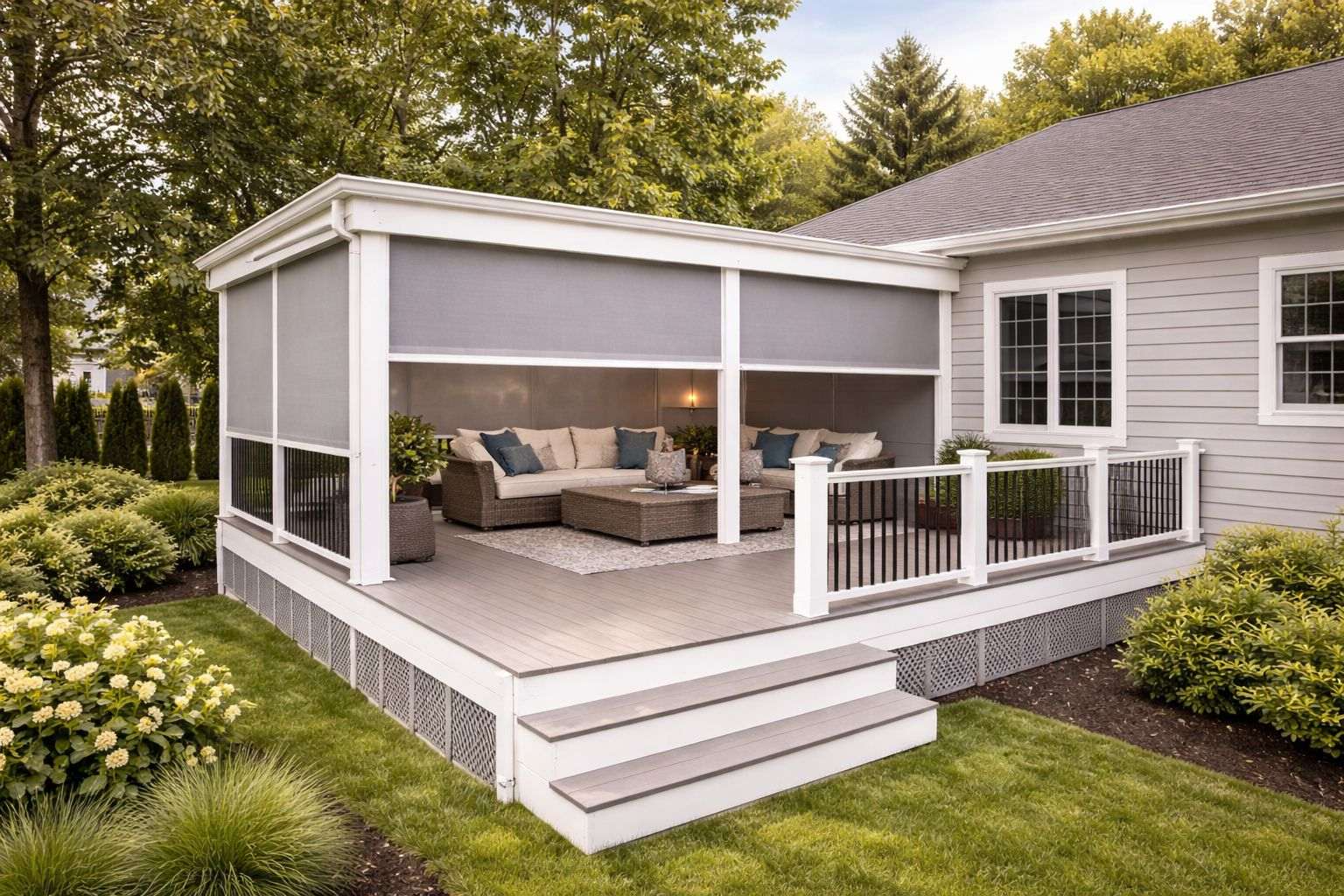
- A fence on an unroofed deck (not in a front yard, and more than 2.4 metres from a street lot line): 2.0 metres above the surface of the deck.
Do other GTA municipalities use the same limits?
No. Vaughan, Markham, Richmond Hill, Aurora, and Newmarket each have their own fence bylaw, and the heights and conditions differ. The figures above are from the Toronto bylaw as the City published it when this guide was written in October 2026. Check your own municipality before you build, and check again if you are reading this much later.
Why does a 2-metre fence often fail to hide a deck?
Because privacy is about angles, not about the boundary. Two situations defeat a legal fence:
- A raised deck. If the deck surface is 1.2 metres above the yard and your eyes are about 1.2 metres above the deck when seated, you are looking out from 2.4 metres up, over the top of a 2.0 metre fence. The neighbours can see you just as easily.
- A second-storey window. A neighbour looking down from an upper floor sees over any fence you are allowed to build, straight onto the patio table.
What does a privacy screen do differently?
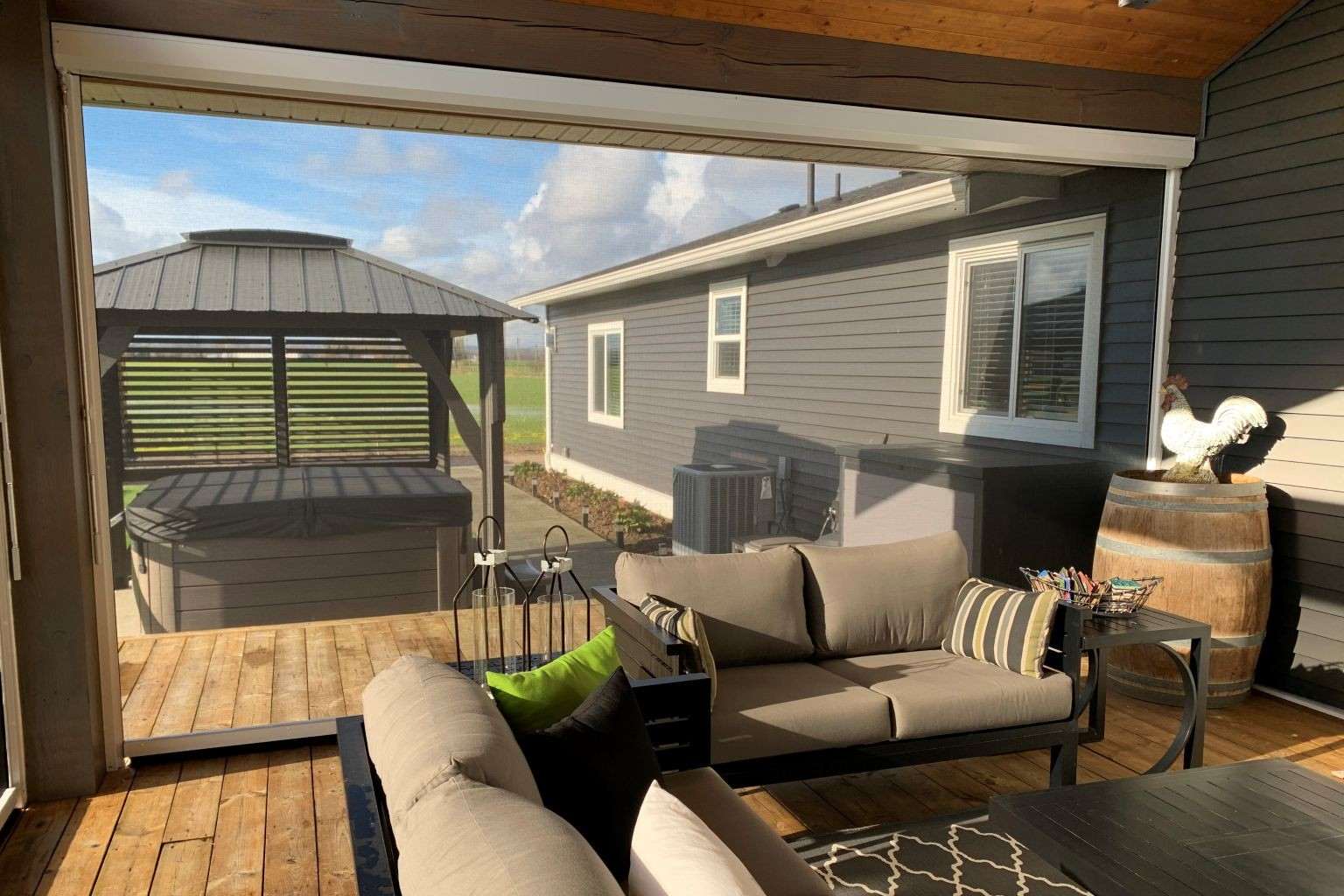
A screen is mounted where you sit instead of where the lot ends. It drops from a housing on the pergola beam, porch header, or deck roof and runs in side channels down to a bottom bar, so it covers the opening from top to bottom on the side that faces the neighbour.
It also retracts. With the screen up, the deck is open and the view is back. A fence is permanent in both directions. The fabric you choose sets how much shows through, from open insect mesh to a solid blackout sheet, and the same screen cuts low sun and wind while it is down.
Does a privacy screen count as a fence?
It can. Toronto defines a fence broadly, as a barrier "or any structure, except a structural part of a building, that wholly or partially screens from view, encloses or divides a yard or other land." A freestanding fixed privacy panel on a deck fits that description, which is why the bylaw has a specific row for fences on unroofed decks.
A retractable screen fixed to a roofed porch, pergola, or covered deck is a different kind of installation: it is attached to a structure and rolls away when not in use. How a municipality treats it depends on the details, so we raise it at the site visit and recommend confirming with your municipality before work starts. Our guide to permits for privacy screens and awnings in Ontario covers the building permit side, and condo boards have their own rules on top.
Fence or screen: how do they compare?
- Height: a fence is capped by bylaw, measured from the ground. A screen covers the opening it is mounted in, at whatever height the deck or porch sits.
- What it hides: a fence hides the yard from people at ground level. A screen hides the seating area from people beside and above it.
- Flexibility: a fence is always there. A screen goes up and down.
- Sun, wind, and insects: a fence does little for any of them. A screen handles all three, depending on the fabric.
- Boundary and security: a fence marks the lot line and keeps pets and children in. A screen does neither.
- Pools: a pool needs a proper enclosure and, in Toronto, a pool fence enclosure permit. A screen is not a substitute.
When is a fence the right answer?
Choose a fence when the patio is at ground level, the neighbours are single-storey or screened by distance, and the real need is a boundary: keeping a dog in, marking the lot, or enclosing a pool. It is also the right first step if the yard has no fence at all.
When is a screen the right answer?
Choose a screen when the sightline comes from above the fence or from a place a fence cannot go: a raised deck, a pergola or porch overlooked from next door, a townhouse patio with units on both sides, or a balcony, where a fence is not an option at all. Our guide to privacy screens for elevated decks goes further into layouts.
Can you use both?
Most of the yards we work in already have a fence, and the owners still feel watched on the deck. The fence is doing its job at the lot line. The screen is added on the one or two sides of the deck or pergola that face the neighbour, and it comes down when the space is in use.